
Our History
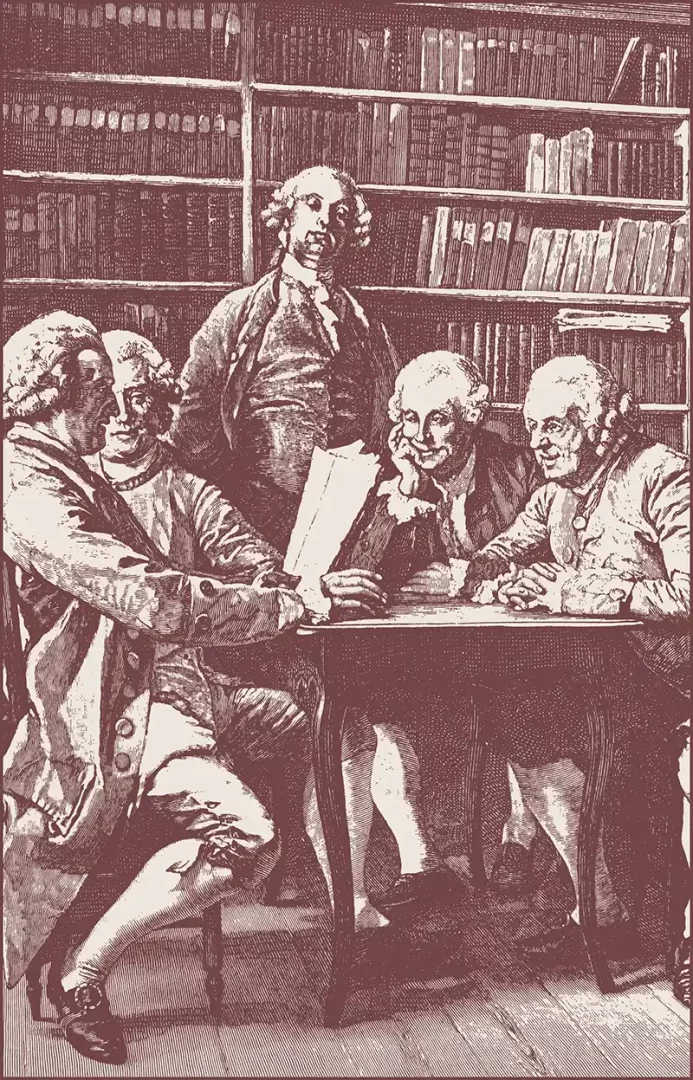
Although the Salem Athenaeum’s charter and name date from 1810, our history began fifty years earlier with the founding of two earlier institutions: the Social Library in 1760 and the Salem Philosophical Library in 1781.
The Social Library, an outgrowth of the Monday Evening Club, was one of many social clubs that were common in the colonial era. Many prominent merchants, lawyers, religious leaders, and other notables of Salem were members.
In 1760, several donated 175 guineas toward the foundation of a library for their mutual use. This new Social Library was stocked by both donations from members’ personal libraries and new purchases from London booksellers. Membership was unrestricted providing applicants could meet the £11 yearly fee (approximately $1500 in current dollars).
In 1781, the Philosophical Library was founded from the spoils of war. During the American Revolution, the ship Pilgrim, a privateer out of Beverly, captured the Duke of Gloucester on September 5 in the Irish Channel. The Duke of Gloucester sailed for Bristol from Galway that same day with the library of Richard Kirwan (1733–1812) and a load of kelp.
Kirwan, recently elected as a Fellow of the Royal Society for his chemistry research, anticipated relocating indefinitely from his family estate, Castle Cregg in County Galway, to London. His library of 116 volumes was seized, transferred to the Pilgrim, and auctioned in Salem on April 12, 1781.
Reverend Joseph Willard of the First Church in Beverly learned of the Kirwan library and gathered a group of associates to pool resources to purchase it. Organized as the Philosophical Library, the volumes circulated to members and remained at Willard’s residence in Beverly until he was elected President of Harvard College. The collection then transferred to Reverend John Prince at the First Church, Salem.
Over time, members added the latest scientific works and serials, increasing the collection threefold. Costly serial subscriptions kept the annual assessments high and led to the eventual decision to merge with the Social Library to form the Salem Athenaeum.
The Revolutionary War took a heavy toll on the Social Library. The cost of living soared, goods were difficult to attain, and most members were preoccupied with protecting their interests. Several members were loyalists who fled Salem.
Since many members of the Philosophical Library already belonged to the Social Library, the merger of the two was a mutually favorable decision.
The name “Athenaeum,” an artifact of the Age of Enlightenment, suggests the members’ aspirations to increase each other’s knowledge as a group and to pursue the improvement of society and themselves.
Today the Athenaeum houses over 50,000 volumes in its circulating and research collections. The welcoming reading rooms and garden offer opportunities for quiet work and reflection during the day and host a variety of cultural programs including concerts, readings, lectures, performances, and lively social gatherings after hours.
Prominent members and patrons of the Athenaeum have included Edward Augustus Holyoke, physician and a founder of the American Academy of Arts & Sciences, the Reverend Dr. William Bentley, American Impressionist painter Frank W. Benson, literary patron Susan Burley, mathematician Nathaniel Bowditch, author of the still-used New American Practical Navigator, author Nathaniel Hawthorne, Charles Grafton Page, an early inventor of the electric motor, philanthropist Caroline Plummer, United States Supreme Court Justice Joseph Story.